Sabre and Agentic AI in Travel: « It’s Not Your Mama’s Sabre »
Cassidy Smith-Broyles’s first interview with a French-language travel publication. Senior Director, Head of Global PR at Sabre, she speaks ahead of her appearance at Next Tourisme on June 4th in Paris: agentic AI, responsibility when bookings go wrong, the future of travel agencies.
— By Nicolas François, April 13, 2026
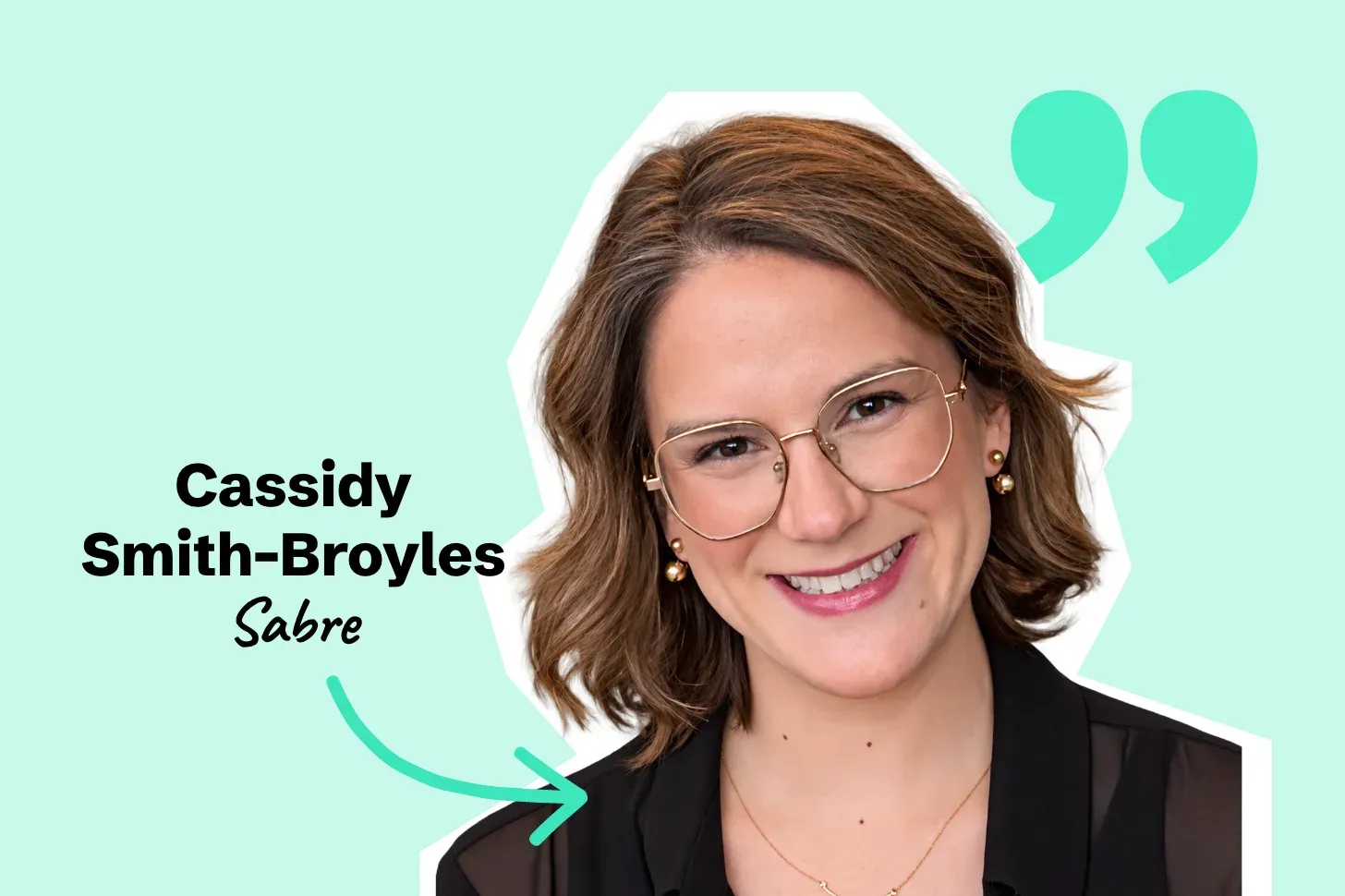
Agentic AI in travel, responsibility when bookings go wrong, the future of travel agencies... I had the chance to sit down with Cassidy before her appearance at Next Tourisme on June 4th in Paris.
Sabre. For most travel professionals, it’s first and foremost a GDS, a Global Distribution System: the invisible digital backbone of global travel, the system that gives agencies instant access to the inventory of thousands of airlines and hotels around the world. Massive, historic, indispensable. Not exactly what you’d spontaneously associate with innovation.
And yet, agentic AI is precisely where Sabre has been placing its bets for the past six years. The partnership with Mindtrip and PayPal, planning, booking and payment in a single conversation, is probably the most concrete proof of what that looks like in practice.
Nicolas François: You joined Sabre 18 months ago, right in the middle of the AI acceleration. What surprised you most about what the travel industry understands, or still doesn’t, about agentic AI?
Cassidy Smith-Broyles: Two things. First, the pace of acceleration. Things that were still pilots or ideas 18 months ago have become reality. And it’s not slowing down.
Second, I’m still surprised that there are many voices in the travel industry who aren’t sure it can really happen, that consumers won’t trust agentic AI enough to book a trip through it. I understand the caution: travel is emotional, it’s a big-ticket purchase. But for me, it’s a question of when, not if.
We’ve seen this before. Nobody wanted to shop online or bank online, those were too important, too risky. Today, you’d be hard pressed to find someone who’d rather go into a bank branch. The same shift is happening in travel.
And then there’s what I’ve seen from inside Sabre. I love saying: it’s not your mama’s Sabre. The last six years have been spent preparing for exactly this moment. The monolithic systems that had been running the same way for decades weren’t going to be the agile systems needed to pivot to what’s coming. Sabre knew that. When we started talking about it publicly, people were surprised to see how far ahead we were. I wasn’t surprised.
The Mindtrip and PayPal partnership promises something very specific: one conversation to plan, book and pay. Where does that stand today, and what does Sabre bring to this that others simply can’t?
At the most basic level, this partnership is about turning a conversation into a completed booking, without losing the traveler along the way, without sending them somewhere else to finish the transaction. A lot of players talk about « conversational commerce, » but in practice, they take you to the inspiration phase and then redirect you to another site to actually book. That’s not what we’re doing.
On timing: stay tuned for an announcement in Q2, probably sooner than anyone’s expecting. The roles are clear: Mindtrip brings the consumer-facing front-end experience, PayPal handles secure payment, and Sabre is the execution layer. That’s our role. And it’s what we’ve been doing for sixty years.
What’s hard to replicate is the infrastructure. If you’ve traveled in the last sixty years, there’s a good chance Sabre facilitated part of that trip. You can count on less than one hand the number of companies that could bring this scale, this trust, this execution capability to the table. That depth doesn’t get built in a few months.
Sabre published a white paper on trust and governance in agentic AI. You write that trust must be « designed, demonstrated, and durable. » Concrete question: if an AI agent makes a booking error, who’s responsible? And how can a travel professional actually trace what happened?
The best way to think about it: AI changes how work gets done, but it doesn’t remove responsibility from the entities involved. That responsibility lives across the agentic chain, and ultimately remains with the business on whose behalf the agent acted. That’s not so different from today, where responsibility shifts between the agency, the tech provider, the tour operator depending on the stage of the trip. That doesn’t go away with AI.
What has to be built in from the start is traceability. Every action an agent takes must be auditable: who acted, when, with what authorization, with what consent. At Sabre’s scale, cybersecurity and governance are already part of our DNA. That’s not new for us.
And for the immediate future, there’s the principle of human in the loop: AI gets you to a certain point, a human oversees, confirms, verifies. That’s not a temporary measure, it’s the right way to build trust progressively.
For a travel agency already using Sabre today, do they become a passive beneficiary of this shift, or do they have an active role to play?
Both. And it’s up to each agency to decide how far they want to go.
With Mindtrip specifically, there will be concrete opportunities for agencies to step in and handle post-booking servicing. That’s where complexity, customer frustration and real human value-add live. Agencies that want to position themselves there will be able to do so as preferred partners.
More broadly, adoption follows a path from simple assistance toward what we call managed autonomy. Agencies set their own boundaries. Nobody is forcing an agentic AI experience on them.
What I always come back to: agentic AI reshapes workflows. It doesn’t replace expertise. Routine, repetitive, high-volume tasks, that’s where AI excels. Judgment calls, exceptions, customer relationships: humans remain essential. And frankly, AI isn’t particularly warm. It doesn’t really understand those dimensions yet. Nobody seriously argues with that.
Last question. What can agentic AI not yet do in travel, and what do you not expect to see solved in the next 18 months?
What will progress very fast is everything well-defined: clear workflows, clear rules, objective success criteria. That kind of task will be handled much better in the next six to twelve months, and people will get comfortable with it.
What won’t be solved in 18 months? Everything involving high ambiguity, emotional context, negotiation, empathy. The truly human skills. Judgment will remain essential well beyond that window. Will we ever get to something entirely, truly agentic? I don’t know. What I know is we’ll go much further in that direction.
And ultimately, I think we’ll reach a point where each traveler chooses: do I want to handle this entirely through AI, or would I rather pay a bit more to have a human take care of it? Both will coexist. Early adopters will help iron things out for those who are slower to come on board. That’s always how it works.
☕️ My take: what this means for travel professionals
Cassidy speaks well. Very well. She knows exactly what she wants to say, and what she won’t say yet (the Q2 Mindtrip announcement is still under embargo, and she won’t budge on that :). But behind the polished communication, there’s real substance.
What strikes me is Sabre’s deliberate repositioning, away from the « legacy system » image, toward becoming the trusted infrastructure of the agentic era. Listening to Cassidy, it’s clear this is consistent with six years of investment. And it maps to something real, even if June will be the real test.
The question is no longer « will AI change travel? » It’s « where in the chain do I want to stay active? » The post-booking servicing angle Cassidy mentions is a concrete lead worth exploring. And the human-in-the-loop principle should be part of every strategic conversation right now.
More to come at Next Tourisme on June 4th in Paris.
Further reading
- The Secure AI Advantage: Governance and Trust in Travel Technology, the Sabre white paper referenced in this interview
- Mindtrip: the AI agent that wants to reinvent travel booking
Thanks to Branko Karlezi for making this happen.

Creator of IA, Tech & Travel Café ☕️. I help tourism professionals embrace AI with curiosity and method. MIT-certified and Digital Director, I bring 20 years of hands-on experience to AI that actually makes sense.
Rendez-vous le mois prochain
Des analyses concrètes et des outils testés pour votre métier.
3 000+ abonnés · Une newsletter par mois